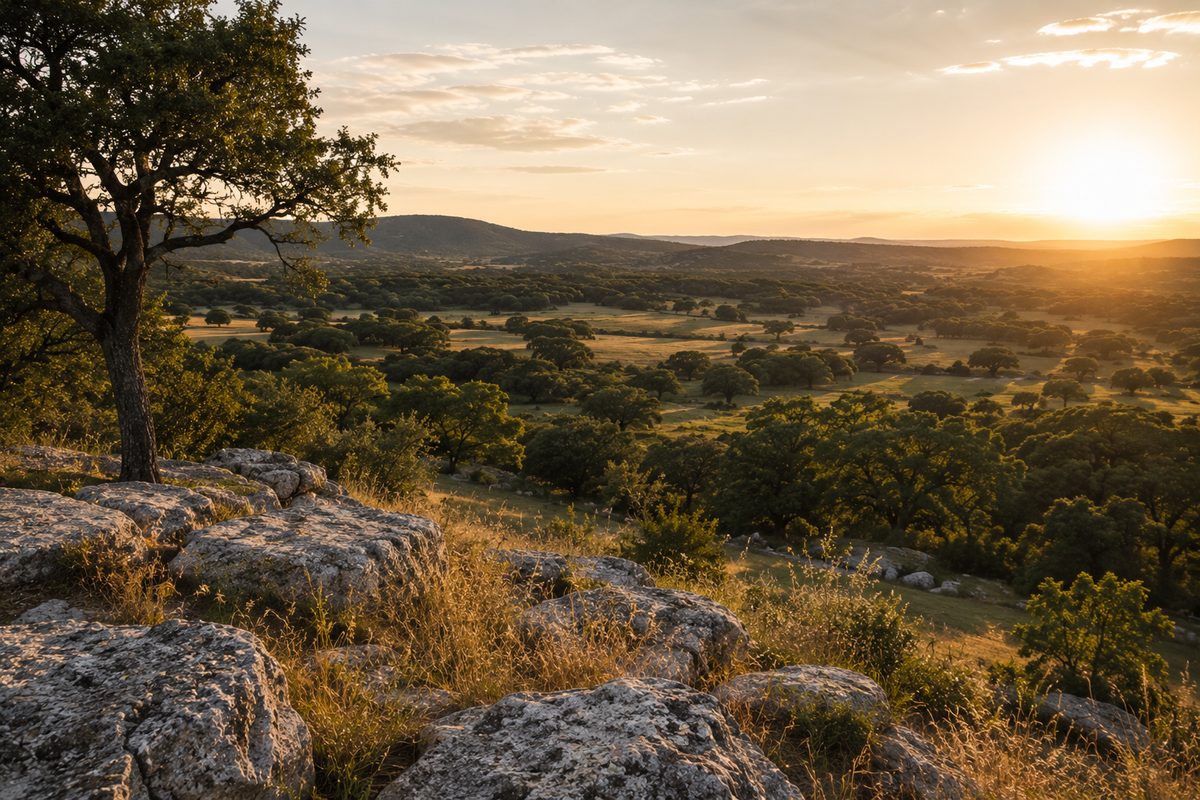
Blanco County Texas ranch land landscape at golden hour

Section 01

Why Buy a Ranch in Blanco County?

Blanco County sits at the geographic and cultural center of the Texas Hill Country — and it is consistently one of the most active ranch markets in the state. Here is why buyers continue to choose it.

Proximity to Austin

Johnson City is 55 miles west of downtown Austin — roughly 60–75 minutes. That makes Blanco County the closest Hill Country ranch market to one of the fastest-growing cities in the United States.

Hill Country Lifestyle

Live oaks, limestone bluffs, open pasture, and live water creeks define the landscape. The county offers hunting, fishing, equestrian use, and privacy that buyers cannot find closer to the city.

Investment Potential

Land supply in Blanco County is finite and demand from the Austin–San Antonio corridor continues to grow. Historically, Hill Country ranch land has held value well through economic cycles.

Water Resources

The Blanco and Pedernales Rivers run through the county. The Trinity Aquifer supports productive water wells across much of the area. Live water frontage is one of the county's most valuable features.

Recreation

Hunting (whitetail, turkey, hog, dove), fishing, hiking, horseback riding, and swimming holes. The county also sits near Enchanted Rock State Natural Area and the Pedernales Falls State Park.

Tax Advantages

Active agricultural and wildlife exemptions reduce taxable value by 80–95%. Blanco County has a well-established process for ag and wildlife valuation, making tax planning straightforward for qualified properties.

Section 02

Blanco County Ranch Market Overview

A snapshot of the Blanco County ranch market to help you understand where values stand and what drives price differences between properties.

MetricDetails
Price Range Per Acre$8,000 – $20,000+ depending on water, improvements, and access
Live Water PremiumRiver and creek frontage properties command 30–60% premium over comparable dry land
Common Ranch Sizes20–50 acres (recreational), 50–200 acres (hunting/ranching), 200–1,000+ acres (investment/legacy)
County SeatJohnson City
Major TownsBlanco, Johnson City, Round Mountain, Cypress Mill, Twin Sisters
Primary UsesRecreational, Hunting, Horse, Investment, Working Cattle
Distance to Austin55–65 miles west (60–75 min)
Distance to San Antonio60–75 miles northwest (75–90 min)
Ag ExemptionAvailable for livestock grazing, hay, beekeeping, orchard, wildlife management
Primary Water SourceTrinity Aquifer (wells); Blanco and Pedernales Rivers (surface)
Primary Game SpeciesWhitetail deer, wild turkey, feral hog, dove
Typical Closing Timeline30–60 days from executed contract

Section 03

Best Areas to Buy Ranch Land in Blanco County

Blanco County has five distinct sub-markets. Each has its own character, price dynamics, and buyer profile.

Johnson City

County Seat · Central Location

Johnson City is the commercial and logistical hub of Blanco County. It sits at the intersection of US-290 and US-281, making it one of the most accessible ranch markets in the Hill Country. LBJ National Historical Park is located here, and the town has a small but established service base — feed stores, equipment dealers, veterinarians, and a reliable title company.

Strengths: Accessibility, services, established market comps, Pedernales River proximity.

Ideal Buyer: First-time Hill Country buyer, weekend retreat seeker, buyer who wants access to services without sacrificing open space.

Blanco

River Town · Southern County

The city of Blanco anchors the southern part of the county along the Blanco River. Live water access is the defining feature here — the Blanco River corridor has some of the county's most desirable and competitive ranch listings. The town itself has grown considerably in recent years with restaurants, a weekend market, and a renovated town square.

Strengths: Blanco River frontage, established community, proximity to Wimberley and San Marcos corridor.

Ideal Buyer: Buyer prioritizing live water, buyer with ties to the I-35 corridor, equestrian and recreational buyer.

Round Mountain

Privacy · Northern County

Round Mountain sits on the northeastern edge of Blanco County where it meets Burnet County. It offers a more remote character than Johnson City while remaining within easy reach of Austin. Properties here tend to be larger, with lower density and more working ranch infrastructure. The Pedernales River runs through this area as well.

Strengths: Privacy, larger tracts, competitive pricing relative to southern county, Pedernales access.

Ideal Buyer: Buyer wanting larger acreage, hunting operation buyer, buyer seeking more remote feel without sacrificing Austin accessibility.

Cypress Mill

Deep Hill Country · Scenic

Cypress Mill is one of the most scenic and least-developed parts of Blanco County. Located on Hamilton Creek near its confluence with the Pedernales, the area has a distinctive Hill Country character with limestone bluffs, large live oaks, and a sense of remoteness rare this close to Austin. Properties here are limited in supply and hold value well.

Strengths: Scenic beauty, water access, limited supply, strong long-term value.

Ideal Buyer: Legacy buyer, privacy-focused buyer, buyer who will hold land long-term.

Twin Sisters

Elevated · Views

Twin Sisters sits in the higher-elevation western reaches of Blanco County near the Kendall County line. The terrain is more dramatic here — limestone ridgelines, cedar-oak breaks, and broad views. Properties are typically larger working ranch operations. The area is less developed than the eastern county and attracts buyers seeking true ranching character.

Strengths: Dramatic terrain, elevation, working ranch infrastructure, lower density.

Ideal Buyer: Working cattle or horse buyer, buyer seeking dramatic Hill Country terrain, long-term investment buyer.

Section 04

Types of Ranches in Blanco County

Not all Blanco County ranches are the same. Knowing which category fits your goals helps narrow the search before you start looking at properties.

Hunting Ranches

Configured for game production — whitetail deer, turkey, hog, dove. Typically feature established blinds, protein and corn feeders, wildlife water sources, and existing game management history. May include high-fence infrastructure. Often carry an active wildlife exemption.

Horse Ranches

Equipped for equestrian use — improved pasture, perimeter and cross fencing, barns, water troughs, and sometimes an arena or round pen. Look for flat to gently rolling terrain, adequate water supply, and quality road access for horse trailers.

Live Water Ranches

Defined by frontage on the Blanco River, Pedernales River, Cypress Creek, or a year-round spring. Live water is the most valued and most competitive category in Blanco County. These properties move quickly and carry a significant price premium over comparable dry land.

Recreational Ranches

Designed for lifestyle enjoyment rather than agricultural production — weekend getaways, family compounds, outdoor adventure. May include a cabin or guest house, a stock tank for fishing or swimming, and managed grounds for privacy and aesthetics.

Luxury Ranches

Fully improved estates combining high-end residential construction with working ranch infrastructure. These properties typically feature a main residence, guest quarters, a barn complex, swimming pool or water feature, and extensive landscaping — all within a working ranch or wildlife management context.

Investment Ranches

Acquired primarily for long-term land appreciation. Buyers in this category prioritize location relative to growth corridors, ag exemption status to minimize holding costs, and land characteristics that support future value — water, access, developable terrain.

Blanco County Hill Country landscape at sunset

Section 05

Blanco County Ranch FAQ

Answers to the most common questions buyers ask about Blanco County ranch real estate.

Is Blanco County a good place to buy a ranch?

Yes. Blanco County is one of the most sought-after ranch markets in the Texas Hill Country. It offers proximity to Austin and San Antonio, strong water resources, established ag exemption infrastructure, and consistent demand that has supported land values over time. It is a strong market for lifestyle buyers and long-term investors alike.

What is the average price per acre for ranch land in Blanco County?

Ranch land in Blanco County generally ranges from $8,000 to $20,000+ per acre depending on water, improvements, road access, terrain, and exemption status. Live water tracts command a significant premium. Properties with active ag exemptions and good fencing tend toward the higher end of the range.

How much land do I need for an ag exemption in Blanco County?

There is no fixed minimum acreage, but the Blanco County Appraisal District evaluates each application based on actual agricultural use — livestock, hay, beekeeping, or wildlife management — over the previous five of seven years. In practice, most successful applications involve at least 10 acres with documented agricultural activity.

Can I hunt on my Blanco County property?

Yes. Hunting on private land in Texas is legal and common in Blanco County. Whitetail deer, wild turkey, feral hog, and dove are the primary game species. Many properties have established blinds, feeders, and wildlife water sources. A wildlife management exemption can also maintain ag valuation through active wildlife practices.

What are the best areas near Austin to buy a ranch in Blanco County?

Johnson City is the most accessible for Austin-area buyers at approximately 55 miles west via US-290. Round Mountain offers similar proximity with more privacy. The city of Blanco anchors the southern county with Blanco River access. All are within 90 minutes of downtown Austin — viable for weekend use.

Are water wells common in Blanco County?

Yes. Wells are the primary water source for most rural properties in the county, drawing from the Trinity Aquifer. Depth, static water level, and yield vary significantly by location. Always request the TCEQ well log and conduct an independent well test during the due diligence period.

What taxes apply to ranch land in Blanco County?

Property taxes are assessed by the Blanco County Appraisal District. With an active ag exemption, land is taxed on productive agricultural value rather than market value — reducing assessed value by 80–95%. Without an exemption, taxes are assessed at full market value, which can be substantial on larger tracts.

Is Blanco County growing in population and land value?

Yes. Blanco County has seen consistent population growth driven by remote workers, retirees, and Austin-area residents. This demand has put sustained upward pressure on land values. The county's proximity to the Austin–San Antonio corridor and limited land supply make it a strong long-term land market.

What is a wildlife exemption and how does it work?

A wildlife management exemption allows land that previously qualified for ag valuation to maintain that tax status through active wildlife management practices — habitat improvement, supplemental feeding, predator management, census counts. The land does not need to be leased for hunting. It is popular with owners who want low property taxes without running livestock.

What is the difference between a hunting ranch and a recreational ranch?

A hunting ranch is primarily configured for game production — blinds, feeders, water features — and may have active hunting leases. A recreational ranch emphasizes broader outdoor lifestyle use: fishing, hiking, equestrian activity, camping, or privacy. Many Blanco County properties serve both purposes effectively.

Do ranches in Blanco County come with mineral rights?

Not always. In Texas the mineral and surface estates are legally separate. Many Blanco County properties have partially or fully severed mineral rights from previous transactions. Always review the title commitment carefully for mineral reservations before closing on any ranch property.

What river or creek access is available in Blanco County?

The Blanco River runs through the southern county; the Pedernales crosses the northern portion near Johnson City and Round Mountain. Cypress Creek and seasonal tributaries provide additional water features. Properties with deeded frontage on live water sources command significant premiums and are among the most competitive listings in the market.

How far is Blanco County from Austin?

Johnson City is approximately 55 miles west of downtown Austin — about 60 to 75 minutes depending on traffic. The city of Blanco is approximately 50 miles west. Round Mountain and Cypress Mill are similarly accessible, making Blanco County one of the closest Hill Country ranch markets to the Austin metro.

What is the best ranch size for a first-time buyer?

For a weekend retreat or recreational use, 20–75 acres offers a good balance of privacy, manageability, and cost. For ag exemption qualification through grazing or hay, 50–100 acres is more practical. Buyers interested in hunting operations or investment typically look at 100+ acre tracts.

Are there deed restrictions on ranch land in Blanco County?

Some subdivisions and planned rural developments have deed restrictions limiting use or further subdivision. Most raw land in unincorporated areas has no restrictions. Your title commitment will identify any recorded restrictions affecting the specific property you are considering.

How long does it take to close on a ranch in Blanco County?

Most transactions close in 30–60 days from executed contract. Complex deals involving mineral title searches, survey disputes, or lender financing on large tracts can take 60–90 days. Cash buyers with motivated sellers can move faster. The title company coordinates the mineral search, survey review, and closing.

What should I look for in a water well before buying?

Key metrics: total depth, static water level, pumping capacity in gallons per minute (GPM), and water quality. A well producing 3–5 GPM is generally adequate for household use; livestock or irrigation needs require significantly more. Request the TCEQ well log and conduct an independent test during due diligence.

Is cedar clearing necessary and how much does it cost?

Cedar encroachment is extremely common on Blanco County land and reduces carrying capacity for livestock and competes with native grasses. Clearing typically costs $300–$600 per acre depending on density. A heavily cedar-encroached property may appear underpriced but require significant investment before it performs as a productive ranch.

What is a rollback tax and when does it apply?

A rollback tax is triggered when land with ag valuation changes to a non-agricultural use. It equals the difference between taxes paid under ag valuation and what would have been owed at market value for the preceding five years, plus 7% annual interest. This can represent a meaningful liability — always understand the exemption status before closing.

How do I find the right ranch broker in Blanco County?

Look for a broker who lives and works in the county — not one based in Austin who occasionally lists Hill Country properties. The right broker walks properties with you, knows local well drillers, title companies, and appraisers, and has a track record of ranch transactions. Joe Quinonez is based in Johnson City and has more than 10 years of experience in Blanco County ranch sales alongside broker Rodney Topper.

Section 06

Talk With Joe About Blanco County Ranches

Joe lives and works in Blanco County. He knows the sub-markets, the sellers, and the land. Fill out the form below and he will follow up directly.

Send Joe a Message

Tell him what you are looking for — size, location, budget, intended use — and he will get back to you directly.

Message sent — Joe will be in touch shortly.
☎ (830) 992-8001 Gillespie County Guide →

Keep Exploring

Related Resources

Guide

The Land

Water, terrain, ag exemptions, and the buying process explained.

County Guide

Gillespie County

Fredericksburg wine country ranch land guide.

Insight

Ag Exemptions

How agricultural valuation works in Blanco County.

Insight

Water Wells

What to ask about water before buying Hill Country land.

Ready to Look at Blanco County Ranches?

Joe is the right first call — he'll help you understand the market before you ever set foot on a property.