Why a Single Number Doesn't Tell the Whole Story
Every buyer and seller wants the same thing first: a number. What's it worth per acre? It's a fair question, and it's also the most misleading question you can ask about rural land if you stop at the county average.
Residential real estate prices roughly track square footage and neighborhood. Rural land doesn't work that way. A 50-acre tract with a year-round spring, paved road frontage, and an active wildlife exemption can be worth two or three times as much per acre as a 50-acre tract a mile away with no water, a handshake easement for access, and heavy uncleared cedar. Both are "Blanco County land." Their price per acre has almost nothing in common.
This article gives you real, current price ranges for the Hill Country market — and then walks through exactly what moves a specific tract up or down within that range.
Current Price Ranges: Blanco & Gillespie County, 2026
Based on current market activity and regional land market reporting, here is where ranch and recreational acreage in the two counties Joe works generally falls in 2026:
- Entry-level / general character land: Below $7,000 per acre — typically larger tracts, heavier cedar cover, no live water, more remote access
- Mid-market Hill Country acreage: $7,000–$10,000 per acre — the broad middle of the market, often with a well, decent road access, and rolling or scenic terrain
- Premium tracts: $10,000–$14,000+ per acre — live water (spring, creek, or river frontage), strong Hill Country views, paved frontage, or an established, income-producing agricultural or wildlife operation
- Trophy / exceptional properties: Above $14,000 per acre — rare combinations of river frontage, elevation, privacy, and improvements in the most sought-after pockets of Blanco and Gillespie County
For context, the broader Austin–Waco–Hill Country region — a designation used by regional land lenders that covers a wider footprint than just these two counties — has averaged in the range of $5,000–$7,700 per acre in recent regional reporting. That figure blends everything from row-crop land to premium recreational tracts, which is exactly why a single regional average isn't useful for pricing an individual Hill Country ranch.
The Five Factors That Actually Set the Price
1. Water
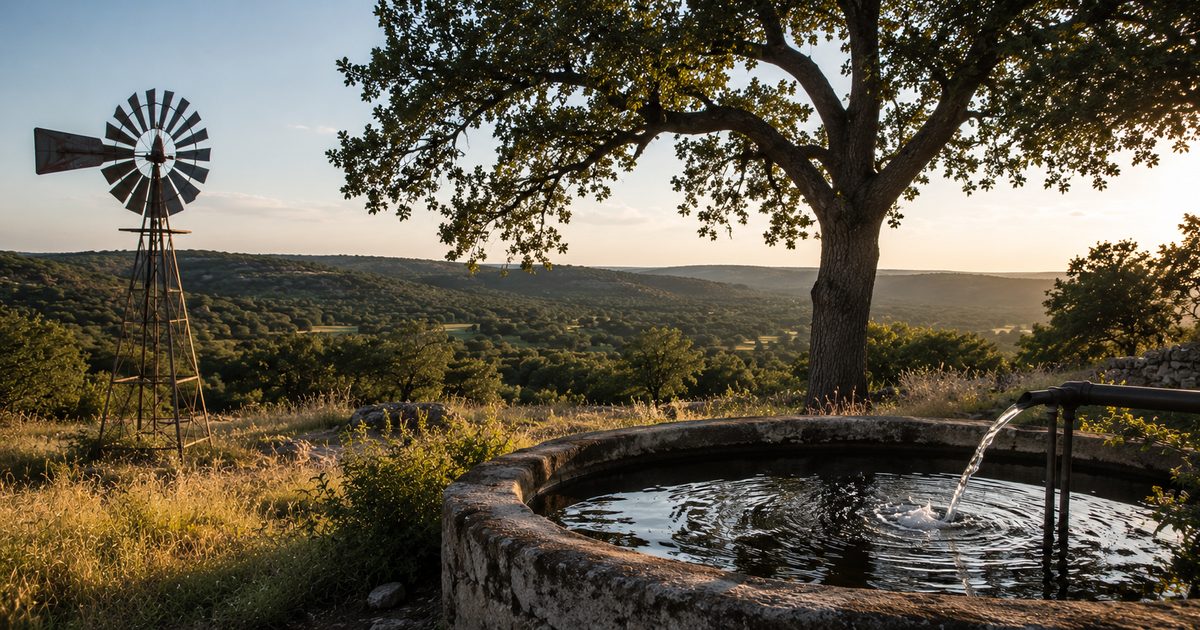
Nothing moves price per acre more than water. A property with a producing well, and especially one with a spring, year-round creek, or river frontage, commands a real premium over dry or unreliable-water land. In a region where a rural water well can cost tens of thousands of dollars to drill with no guarantee of yield, confirmed live water is one of the clearest value drivers in the entire Hill Country market. See our guide to water wells in the Hill Country for how to evaluate a specific well.
2. Legal Access
Deeded, legally documented road access supports a materially higher price than a property relying on a handshake easement or unclear access. Buyers and their lenders both scrutinize this closely, and a landlocked or access-ambiguous tract can sell at a steep discount — sometimes 20% or more below comparable land with clean deeded access. See road access and easements for what to verify.
3. Usable Terrain
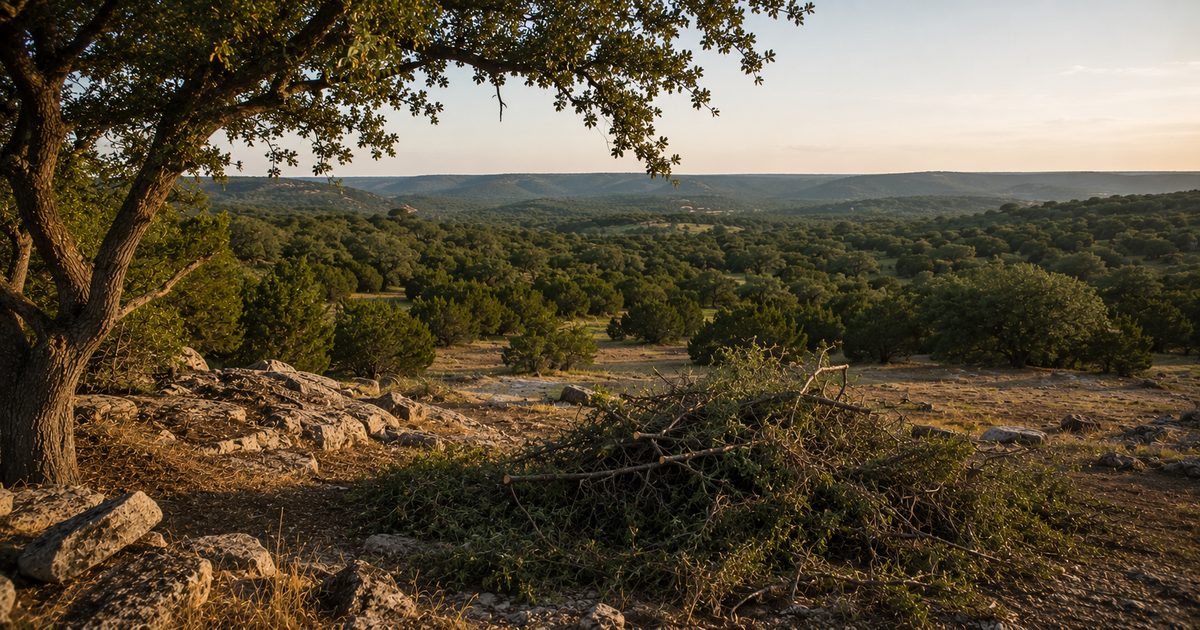
Not all acreage is equally usable. Heavy, unmanaged cedar cover reduces both grazing capacity and visual appeal, which shows up directly in price. Cleared, rolling, or open pasture land commands more per acre than the same footprint buried in cedar. See cedar clearing and land value for typical cost-to-clear and the value lift it produces.
4. Ag or Wildlife Exemption Status
An active agricultural or wildlife management exemption doesn't set the price directly, but it is a real factor buyers weigh — it signals dramatically lower ongoing property tax costs and established, productive land use. All else being equal, exempt land with clean documentation typically outperforms otherwise-identical unexempt land in a competitive market. See our guides on ag exemptions and the wildlife management exemption.
5. Tract Size
Price per acre and tract size move in opposite directions more often than buyers expect. Smaller tracts — particularly under 20 acres — frequently carry a higher price per acre because more buyers can afford the total price, creating more competition for a limited number of smaller parcels, and small tracts often include a home, well, or septic system that adds value independent of the raw acreage. Large ranches (500+ acres) usually see a lower price per acre because the total dollar figure, not the per-acre rate, is what most buyers at that scale are evaluating.
Why County Averages Can Mislead Buyers and Sellers
A published county average is a real, calculated number — it's just calculated across every sale in the county, from a 5-acre in-town lot to an 800-acre working ranch. Averaging those together produces a figure that describes the county in aggregate and describes almost no specific property in it.
This matters most in two situations. A buyer using a county average to judge whether a specific listing is fairly priced can talk themselves out of a genuinely good, water-rich tract because it prices above the average — or into an overpriced dry tract because it happens to sit below it. A seller relying on a county average to set an asking price risks leaving real money on the table on a premium property, or pricing a general-character tract out of its actual market.
How Price Per Acre Is Actually Calculated
Price per acre is the total sale price divided by the surveyed acreage — straightforward math, but it only becomes meaningful once you're comparing genuinely similar properties. Comparing a 15-acre improved tract with a home and well against a 400-acre unimproved working ranch on a price-per-acre basis alone will produce a distorted picture, because the two properties are priced by different market logic entirely. A land surveyor's confirmed acreage — not a tax roll estimate — should always be the denominator in any serious price-per-acre calculation. See our guide to land surveys for why the confirmed number matters.
How Financing Affects What Buyers Can Actually Pay
Price per acre isn't just a function of the land — it's shaped by what buyers can finance. Most rural land buyers in the Hill Country use Farm Credit lenders or USDA programs rather than a conventional mortgage, and those loans typically require 20–35% down with underwriting standards specific to agricultural collateral. That financing reality puts a practical ceiling on what many buyers can pay per acre, regardless of what a seller believes the land is worth. See financing ranch land in Texas for how this works in practice.