What People Call "Cedar" in the Hill Country
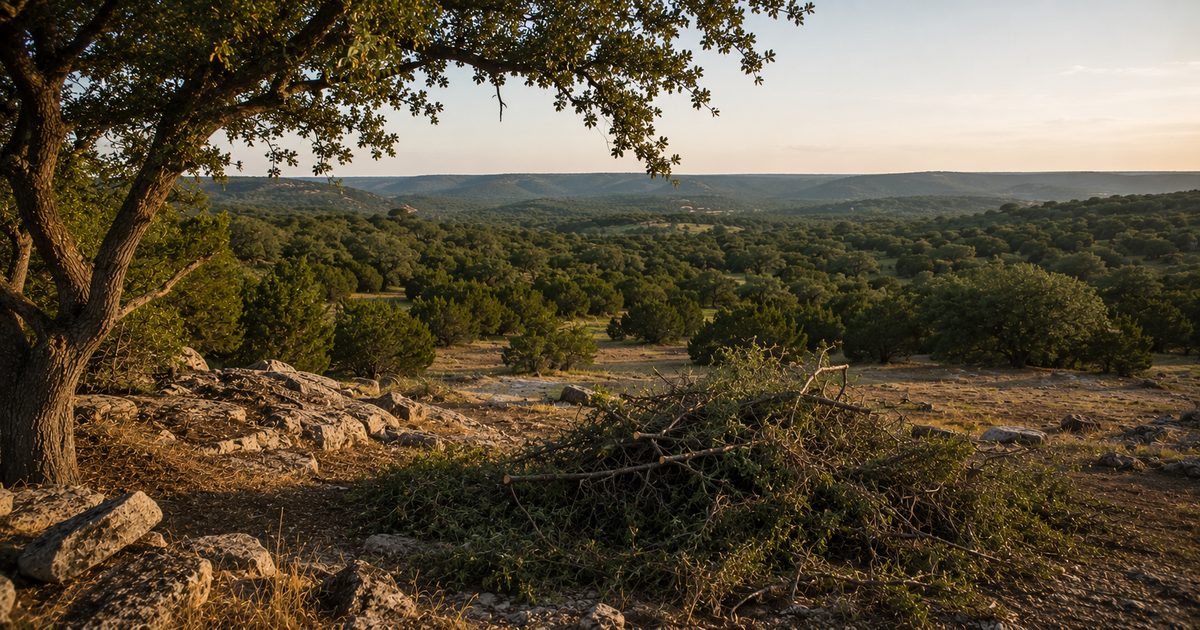
When Hill Country landowners talk about cedar, they're almost always referring to Ashe juniper (Juniperus ashei) — a native, drought-tolerant evergreen that has expanded dramatically across the Edwards Plateau over the past century. It's not technically a cedar; it's a juniper. But "cedar" is the universal term in Blanco County and across the Hill Country, and that's what you'll hear.
Ashe juniper is native to this region and plays a legitimate ecological role — it's critical habitat for the Golden-cheeked Warbler (a federally endangered species that nests exclusively in mature Ashe juniper) and provides food and cover for white-tailed deer, wild turkey, and other wildlife. But at the densities now common across many Hill Country tracts, it becomes a problem for landowners who want productive pasture or open terrain.
Why Cedar Encroaches
Ashe juniper has expanded dramatically across the Hill Country over the past century, primarily due to two related factors: the suppression of fire and the reduction of large grazing animals that historically disturbed the soil and browsed young seedlings. Without periodic fire moving through the landscape, juniper seedlings establish in open grassland and eventually shade out native grasses. Within a generation, a productive pasture becomes a cedar brake.
On many Blanco County tracts, land that was open rangeland in historical photos from the 1940s and 1950s is now densely covered. The change is visible when you look at old aerial photographs — and Joe can often show buyers that comparison for properties they're evaluating.
What Heavy Cedar Does to a Property
- Reduced carrying capacity — a cedar-choked pasture supports a fraction of the livestock that a cleared, grass-covered pasture of the same acreage would. For any buyer with livestock or ag exemption goals, this is the most direct economic impact.
- Water consumption — Ashe juniper has deep root systems and consumes significant water. Dense cedar stands can reduce spring and creek output in dry years, and cleared land often shows improved surface water retention.
- Visibility and access — thick cedar makes the land harder to navigate, reduces sight lines for wildlife management, and in some cases makes roads impassable without brush management.
- Aesthetics — buyers looking for open Hill Country landscape often find heavily cedar-covered land visually unappealing until they understand that the terrain underneath may be excellent.
What Clearing Costs
Cedar clearing in Blanco County typically ranges from $200 to $600 per acre, depending on density, method, and terrain. Common clearing methods include:
- Mechanical clearing (skid steer with mulching head) — the most common method on accessible terrain. Efficient, relatively fast, and leaves mulched material that decomposes and adds organic matter to the soil. Cost varies with cedar density.
- Chainsaw crews — more appropriate for selective clearing, rocky terrain where equipment can't operate, or cedar that's too large for a mulching head. Labor-intensive and slower, but precise.
- Root plowing — used to clear larger cedar and disrupt root systems before replanting improved pasture grasses. More thorough but more expensive, and not always appropriate for Hill Country limestone soils.
- Prescribed burn — effective for managing regrowth after mechanical clearing; requires planning, a burn plan, and appropriate conditions. Not a substitute for initial clearing on heavy infestations.
These are rough figures. Get actual bids on any property where clearing is part of your plan. Costs have increased in recent years with equipment and fuel prices.
Maintenance After Clearing
Clearing is not a one-time event. Ashe juniper resprouts aggressively from the root collar after cutting, and seeds from neighboring properties arrive by bird drop continuously. Without follow-up management, a cleared pasture will begin returning to cedar within 3–5 years.
Effective long-term management strategies include:
- Periodic prescribed burns on a 3–5 year rotation (where conditions allow)
- Mechanical or hand removal of resprouts before they establish
- Maintaining livestock at carrying capacity to keep grasses competitive
- Spot treatment with herbicide on individual resprouts in areas where fire isn't practical
Buyers who plan ahead for maintenance costs — rather than treating clearing as a one-time capital expense — manage their land more successfully over time.
The Golden-cheeked Warbler Consideration
The Golden-cheeked Warbler (Setophaga chrysoparia) is a federally endangered songbird that nests exclusively in mature Ashe juniper — specifically in strips of mature bark it uses to construct nests. It breeds in the Texas Hill Country and is present on many Blanco County properties from March through July.
Federal regulations under the Endangered Species Act restrict clearing of occupied warbler habitat during breeding season and in some cases require additional review. Buyers planning significant cedar removal should understand whether their property falls within warbler habitat and plan clearing schedules accordingly. This is not typically a barrier to clearing — but timing matters, and ignoring it creates legal exposure.
How Cedar Clearing Affects Land Value
The relationship between cedar clearing and land value is direct but not automatic. Cleared land is more valuable than cedar-covered land of the same acreage — but whether a buyer comes out ahead depends on how much they paid for the cedared tract and what clearing actually costs on that specific property.
In Blanco County, the general market dynamic works like this:
- Cedared land trades at a discount. Heavily cedar-covered tracts routinely sell at 10–25% below comparable cleared land in the same area, reflecting the cost and effort required to bring them into production. The discount varies by severity of encroachment and buyer demand at that point in the market.
- Cleared land commands a premium. Buyers willing to pay more for move-in-ready land — open pasture, functional fencing, established grasses — are consistent in the Hill Country market. They pay for the work that's already been done.
- The math on clearing-to-equity. If a 100-acre cedared tract sells at $8,000/acre ($800,000 total) and clearing costs $400/acre ($40,000), the all-in basis is $840,000. Comparable cleared land in the area trading at $10,000/acre ($1,000,000) represents $160,000 in equity created through clearing — assuming the buyer has the patience and capital to execute the plan.
- Water and carrying capacity gains. Beyond price-per-acre comparisons, cedar removal often improves spring output, creek reliability, and soil moisture retention. Restored native grassland supports more livestock per acre, which improves the economics of the ag exemption and any grazing lease income.
The key variable is whether the cedared discount accurately reflects actual clearing costs — and whether the buyer accounts for the time between purchase and when the land reaches its cleared value. Joe helps buyers run this analysis before making an offer, so the numbers support the decision rather than justify it after the fact.
How Long Does Cedar Clearing Take?
Timeline depends on acreage, cedar density, terrain, and contractor availability. Rough benchmarks for a Blanco County property:
- Mechanical clearing (skid steer/mulching head): A single machine operator can clear 5–15 acres per day on accessible terrain with moderate cedar density. Dense, mature stands on rocky terrain slow this considerably. A 100-acre clearing project might take 2–4 weeks of machine time, spread over 1–2 months depending on scheduling.
- Chainsaw crews: Much slower per acre — plan for 1–3 acres per crew per day depending on crew size and cedar size. Used selectively, not for large-scale clearing.
- Phased clearing: Most buyers clear in phases over multiple years rather than clearing the entire property at once. This manages cash flow, allows for grass establishment between phases, and is often more practical for large tracts. A common approach: clear the most productive pasture areas first, leave cedar corridors for wildlife habitat and wind protection, and work additional sections over 3–5 years.
- Regrowth cycle: Allow 3–5 years after initial clearing for native grasses to fully establish on cleared ground before assessing whether a follow-up pass is needed. Rushing the regrowth assessment leads to over-clearing and erosion risk on slopes.
Contractor availability in Blanco County can be a constraint — experienced cedar crews and mulching equipment are in demand, especially after extended dry periods when landowners catch up on deferred maintenance. Plan for 2–4 months of lead time to schedule a major clearing project.