The Distinction in Practice
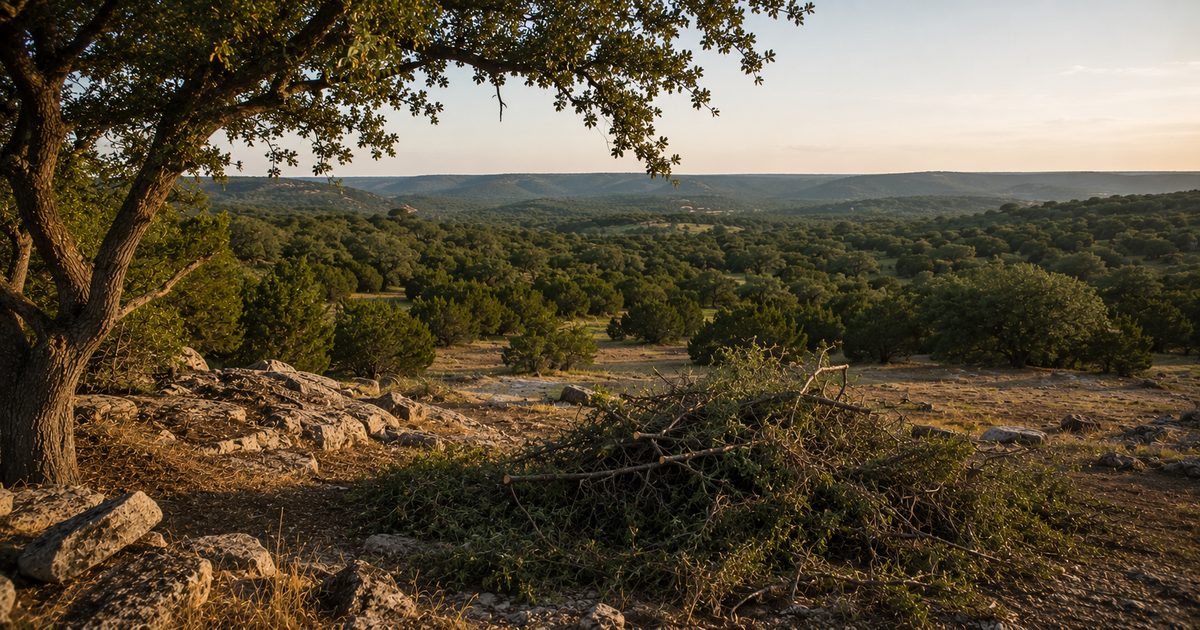
When Hill Country landowners say "cedar clearing," they almost always mean the removal or management of Ashe juniper (Juniperus ashei) — the species that has encroached across much of the Edwards Plateau over the past century. Cedar clearing is the most common land management activity in Blanco County and the surrounding Hill Country, and it dominates conversations about property improvement costs.
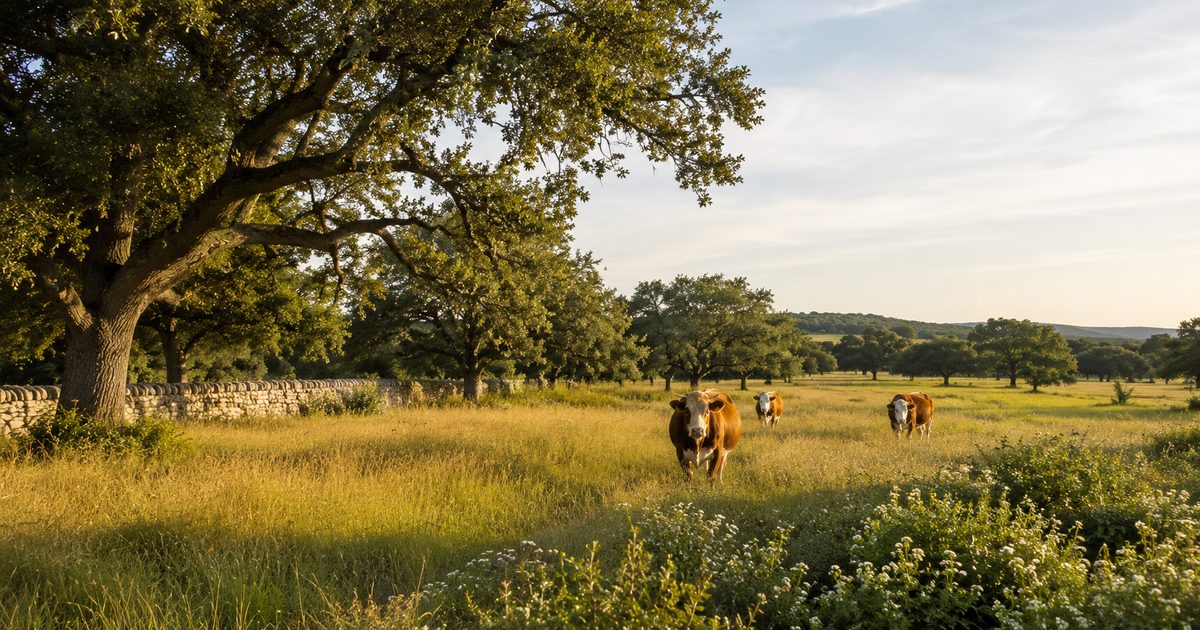
Brush control is a broader term used in range management to describe the management of all encroaching woody plant species — not just cedar. On many Blanco County properties, the "brush" problem includes Ashe juniper, but also Texas persimmon, agarita, shin oak, live oak in mottes that are expanding beyond desirable coverage, and in some areas, prickly pear at densities that reduce grazing capacity.
How the Species Differ — and Why It Matters
Ashe juniper
Ashe juniper responds well to mechanical clearing. A mulching head can process it efficiently, prescribed burns kill seedlings and resprouts effectively, and chainsaw crews can selectively target it. The challenges are scale (it covers enormous acreage in the Hill Country), ongoing resprouting, and continuous reseeding from neighboring properties. It is the most-managed species in the region, and contractors who focus on it are plentiful.
Texas persimmon
Texas persimmon (Diospyros texana) is a native shrub-tree that can form dense thickets competing with desirable grasses. Unlike cedar, persimmon resprouts very aggressively after mechanical removal — often producing a denser stand than was there before cutting. Effective control usually requires herbicide treatment (triclopyr or picloram products applied to cut stumps or as basal bark applications) in addition to mechanical removal. Persimmon that is simply mulched typically comes back harder than cedar does.
Agarita
Agarita (Mahonia trifoliolata) is a thorny native shrub common across the Hill Country. In limited quantities it provides excellent wildlife habitat and is valued by many landowners. At high densities it crowds out grasses and becomes a management issue. It is tolerant of fire and resists mechanical clearing. Herbicide treatment or hand grubbing are the most effective control methods. Most Blanco County land management plans treat agarita selectively rather than eliminating it.
Prickly pear
Prickly pear cactus (Opuntia spp.) is managed differently from woody brush. Mechanical removal (shredding or grubbing) can spread it by distributing viable pads. Herbicide treatment with picloram or triclopyr products is effective but requires careful application timing. Biological control with cochineal insects has been used in some situations. Prickly pear at high densities is particularly problematic for livestock operations and can significantly reduce carrying capacity.
Planning a Comprehensive Management Program
For properties where multiple species are present, a written land management plan — ideally developed with input from a Texas A&M AgriLife Extension range specialist or a certified range manager — is far more cost-effective than addressing each species reactively. A good plan identifies which species are present, their coverage density, the most appropriate control method for each, and a prioritized timeline for implementation.