Why There's No Simple Acreage Answer
The Texas Property Tax Code does not specify a minimum acreage for agricultural special valuation. The determination is based on whether the land is being used for agriculture to a degree of intensity typical for the area — meaning Blanco County farms and ranches operating on similar land. This is a facts-and-circumstances determination, not a bright-line rule.
The practical effect is that the minimum acreage is effectively set by the intensity standards the appraisal district applies to the specific type of agricultural use. Different uses have different effective minimums.
Cattle Operations
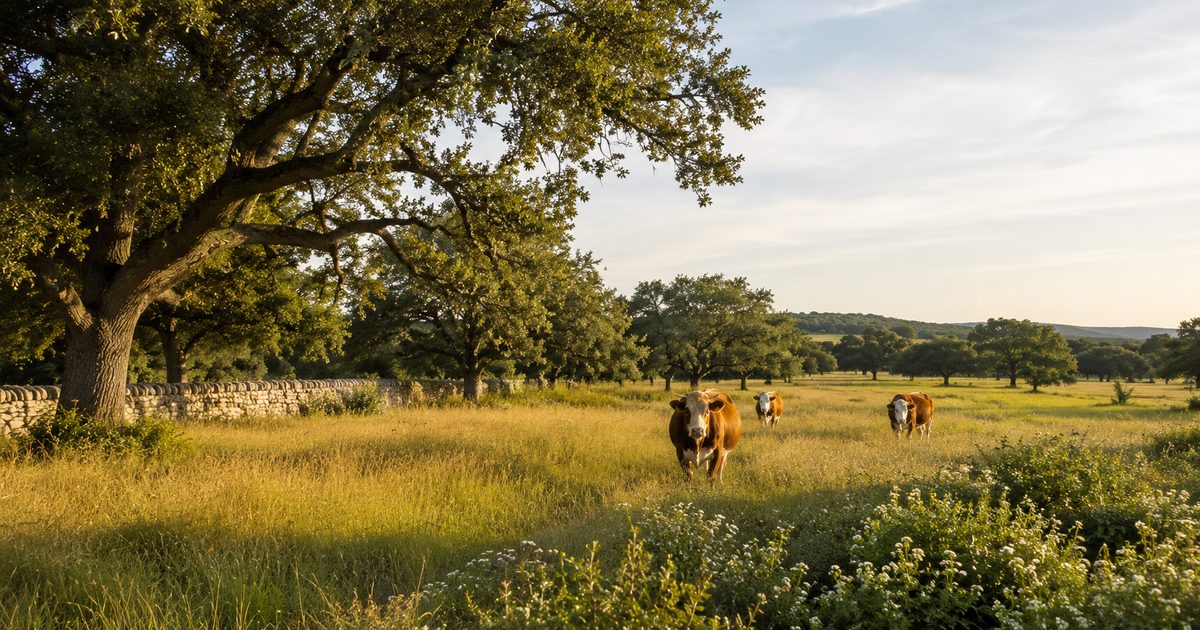
The Hill Country's carrying capacity for cattle is lower than more productive parts of Texas — typically 15–25 acres per animal unit (one cow-calf pair) depending on rainfall, grass coverage, and water availability. To run even one cow-calf pair under a genuine cattle operation, you need 15–25 acres.
For a cattle operation to meet intensity standards — meaning it looks like a real farming operation, not a token use to maintain a tax benefit — you need enough acreage to run a meaningful number of cattle. One cow on 15 acres is technically possible; one cow on 200 acres is not meeting intensity standards. The appraisal district looks at whether your stocking rate is consistent with what a reasonable agricultural operator would run on that acreage.
Hay Production
Hay production qualifies for agricultural special valuation and can work on smaller tracts. The intensity standard looks at whether you are producing and selling hay at commercial volumes, or simply mowing a field and calling it hay production. Documented sales records, baling records, or records of hay fed to livestock on the property support the application.
Wildlife Management
Wildlife management valuation does not have the same stocking rate constraints as cattle. It requires conducting at least three of seven qualifying management activities — habitat control, predator management, supplemental water, etc. — at a level appropriate for the size of the tract. Smaller tracts (20–50 acres) have successfully obtained wildlife management valuation with a well-documented management plan.
The key constraint on wildlife management is that it requires conversion from prior agricultural special valuation — you cannot apply wildlife management valuation to land that was previously at market value.