
Why So Many Owners Are Thinking About Splitting
Recent market reporting for the broader Hill Country shows more sales happening at smaller average acreage per transaction, which suggests demand is strong for tracts that are easier to afford. See Texas Hill Country Land Market Trends. That makes subdividing tempting for owners with a larger ranch, especially heirs or owners who want to keep a homestead and sell the rest. It can work, but the rules, costs, and tradeoffs are more involved than drawing a line on a map.
Does the County Require a Plat?
Under Chapter 232 of the Texas Local Government Code, dividing a tract outside city limits into two or more parts to lay out a subdivision or lots generally requires a plat approved by the county. A plat is a surveyed map of the divided property recorded with the county. There are exceptions, and they are narrower than many people assume:
- The 10-acre exemption. The platting requirement generally does not apply if every lot is more than 10 acres, and only if you aren't laying out a road or other area for public use. A lot of exactly 10 acres does not meet the test, so a 20-acre tract split into two 10-acre pieces generally still needs a plat.
- A family-transfer exception. A tract divided into four or fewer parts, with each part going to a relative within the third degree and no public dedication, can be exempt.
- Small lots. If any lot is five acres or less, a plat is required. County commissioners may also require plats for lots between five and ten acres.
These are summaries of a statute that has been amended and that counties and cities apply in their own ways, including inside a city's extraterritorial jurisdiction. Confirm what applies to your tract with the county and an attorney before you sell any part of it, because selling a lot that should have been platted can create problems for you and the buyer.
Every New Tract Needs Access, Water, and Septic
A tract is only as marketable as its weakest requirement, and each new piece has to stand on its own:
- Legal access. Each tract needs recorded access, not just a road that happens to exist. See Road Access on Rural Texas Land.
- Water. Buyers will ask about well prospects and yield. See Water Wells in the Hill Country.
- Septic. A tract that can't pass a septic soil evaluation is hard to sell as a homesite. See Septic Systems on Rural Texas Land.
Some counties and subdivision rules also add their own water and wastewater requirements, so ask the county early rather than after the survey is done.
Survey, Title, and the Lender
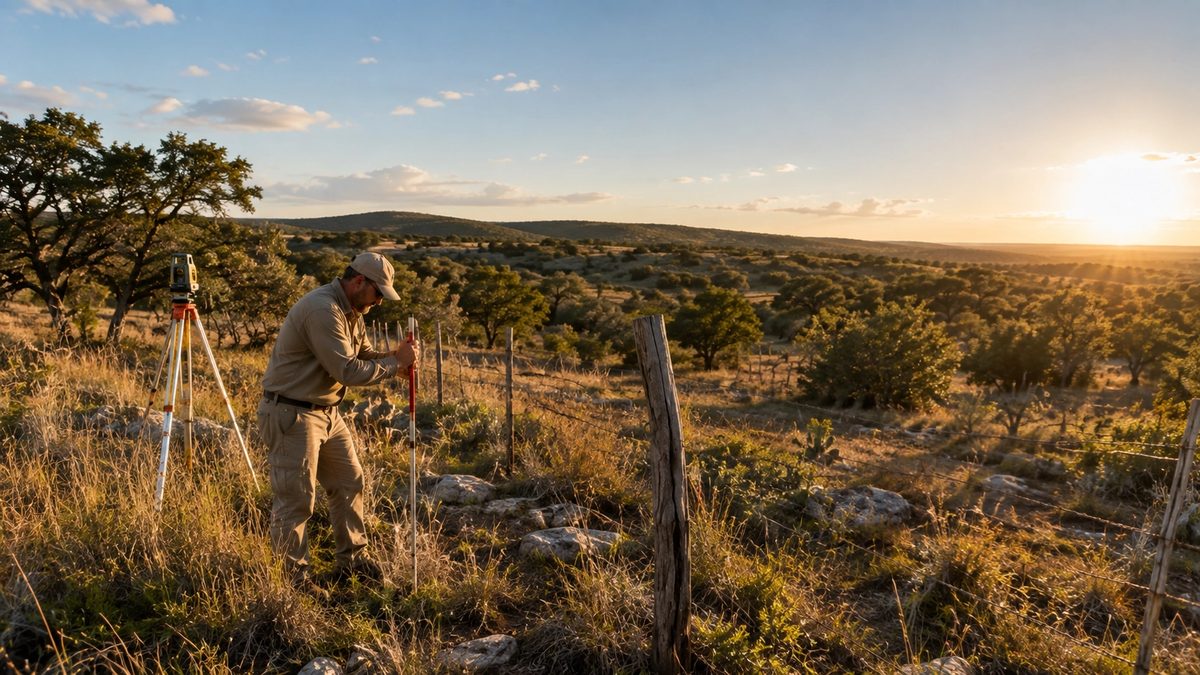
Splitting a tract starts with a surveyor, who will mark the new boundaries and prepare the plat if one is needed. See Land Surveys on Rural Texas Property. Check the existing deed for restrictions and easements that follow the land into every new tract, and if there's a loan on the property, talk to the lender about releasing a portion at closing, because the lien generally covers the whole.
Taxes: Exemptions and Rollback on Smaller Tracts
If the land carries an ag or wildlife exemption, each new owner generally has to qualify on their own, and smaller tracts can be harder to qualify, which affects what buyers are willing to pay. A change of use can also trigger rollback taxes. See Ag Exemptions in Blanco County and the FAQ on rollback taxes. Capital gains on the sale of each piece are a tax question for your CPA, and a 1031 exchange may be an option if you're reinvesting.
Does Subdividing Actually Add Value?
Smaller tracts often carry a higher price per acre than a large ranch, because they attract a wider pool of buyers. See How Much Does Ranch Land Cost Per Acre. But the extra price per acre has to cover the survey, platting, access improvements, possible utility work, and time on the market. Sometimes the whole tract sold to a single buyer nets as much or more with far less hassle.
Alternatives to a Full Subdivision
- Sell the whole tract to one buyer, usually the simplest path.
- Sell part and keep the homestead, which still involves division rules.
- Keep it and lease it while you decide; see Hunting Leases on Texas Ranch Land.
A Practical Order to Work Through
- Ask the county what platting rules apply to your tract and where it sits.
- Get a realistic value for the whole tract and for the pieces.
- Check access, water prospects, and septic suitability for each proposed piece.
- Talk to a surveyor, an attorney, and your lender before you sell anything.
- Review the tax effects with your CPA, then decide.
For the full process of preparing and selling, see Selling Your Land & Ranch.