Utilities Are Not Automatic on Rural Land
When you buy a house in a neighborhood, utilities are already there — power at the panel, water at the meter, sewer at the cleanout, cable to the box. Rural land is different in every way. A 75-acre tract in Blanco County does not come with electricity at the fence, a water tap by the road, or any wastewater infrastructure at all. You start from scratch.
Before you build, place a trailer on the property, run a well pump, or establish any operation that requires power or water, you need to understand which utilities can reach your land, what connecting or installing each one will cost, and what the realistic alternatives are when infrastructure does not extend to a remote location.
Most buyers research this after they fall in love with a property. The better time to research it is during your due diligence period, before you are committed.
Electric Service: Pedernales Electric Cooperative
The primary electric provider throughout Blanco County and most of Gillespie County is Pedernales Electric Cooperative (PEC), one of the largest electric cooperatives in the United States by geographic service area. PEC serves over 400,000 meters across roughly 8,100 square miles of Central Texas. If you are buying rural land in the Hill Country, PEC is almost certainly the provider you will deal with.
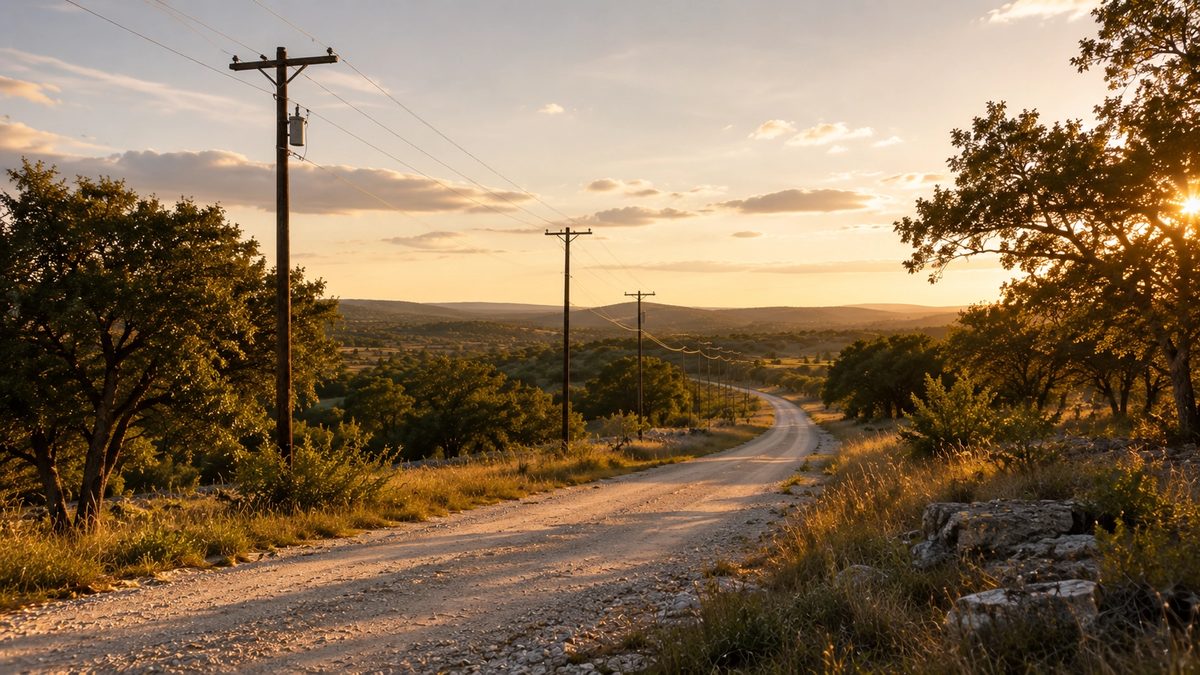
The important distinction is between PEC lines in the vicinity of a property and PEC service at the property. These are not the same thing. Many rural tracts have PEC infrastructure running along an adjacent road or a neighboring easement — but no meter, no service entrance, and no connection to the property itself.
Getting New Electric Service Connected
To establish service on a property that does not currently have it, the process is:
- Contact PEC to determine how far the nearest energized line is from your intended meter location
- Submit a new service application with property location, proposed meter location, and estimated load
- PEC provides a line extension cost estimate based on the distance and terrain
- The landowner pays their share of the extension cost before work begins
PEC's cost-sharing formula works on expected annual revenue from the account. PEC contributes up to a threshold based on anticipated usage; the member pays the difference. A short run from an existing line along a road may cost the landowner very little. A two-mile extension across rough Hill Country terrain can cost $40,000–$80,000 or more — paid upfront, not amortized.
What Electric Extension Actually Costs
Rough ranges for electric line extension costs in rural Texas as of 2026:
- Short run along an existing easement (under ½ mile): $5,000–$15,000
- Moderate extension (½–1 mile): $15,000–$35,000
- Long extension across rough terrain (1–2+ miles): $40,000–$80,000+
These costs must be verified for the specific property — topography, tree clearing, road crossings, and easement requirements all affect the final number. Get a preliminary estimate from PEC during your option period. An $80,000 electric extension you did not budget for changes the economics of a purchase entirely.
Off-Grid Power: Solar and Generators
Solar as a Primary Power Source
For properties where PEC extension is prohibitively expensive or where the owner prefers independence from the grid, off-grid solar has become a practical and increasingly cost-competitive option. The Texas Hill Country receives strong solar irradiance year-round — among the best in the continental United States — making photovoltaic systems well-suited to the region.
A properly designed off-grid system with battery storage can run a residence, a water well pump, lighting, refrigeration, and most standard household appliances indefinitely. Typical installed costs in 2026:
- Small cabin / seasonal use (2–3 kW system): $10,000–$20,000
- Full-time small home (4–6 kW with battery bank): $20,000–$40,000
- Larger full-time residence (8–12 kW): $40,000–$70,000+
When a long PEC extension would cost $60,000 and a complete off-grid solar system costs $30,000, the math often favors solar — especially with no monthly electric bill afterward. Many Hill Country properties use a hybrid approach: connect to PEC if a line is reasonably close, and add solar panels and battery backup for resiliency during outages, which do occur during major weather events in the Hill Country.
Generators
Propane-powered standby generators are common on rural Texas properties as backup power during grid outages. A whole-home standby generator (20–30 kW) with automatic transfer switch runs $8,000–$18,000 installed. Portable generators ($800–$3,000) handle temporary or seasonal power needs on undeveloped tracts. Most rural Hill Country properties keep a generator regardless of whether they are on-grid or off-grid.
Water: Private Wells and Rural Water Supply
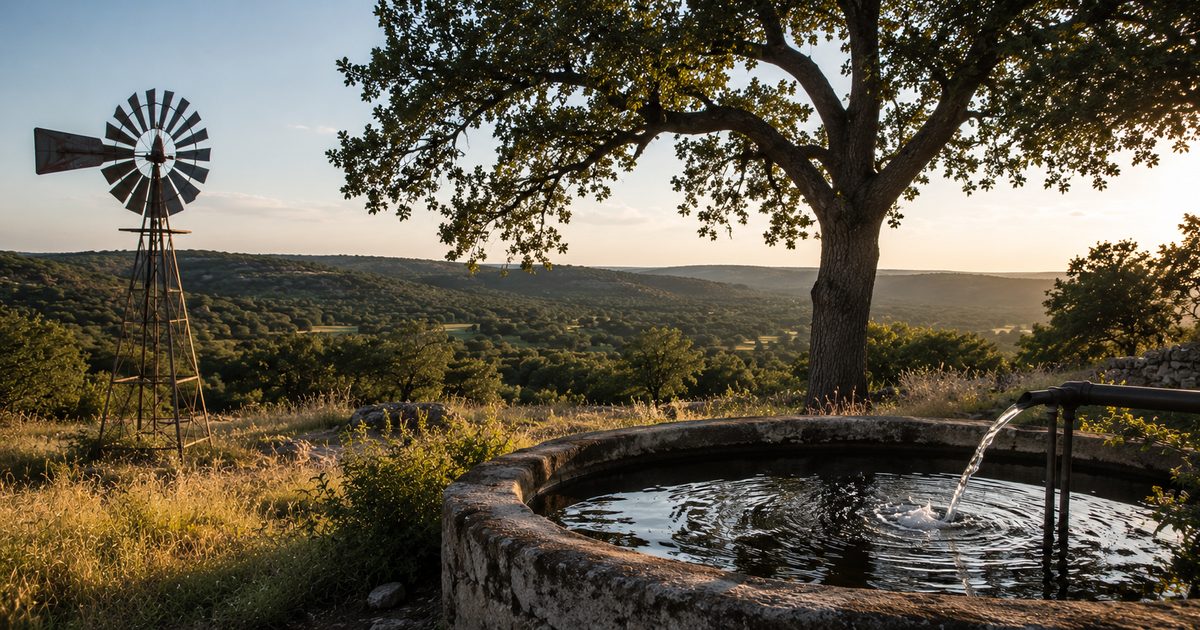
Most rural properties in Blanco and Gillespie County rely on a private water well. The region sits above the Trinity Aquifer system, which provides groundwater to much of Central Texas — though depth, yield, and water quality vary meaningfully by location across the Hill Country.
A well that produces 3–5 gallons per minute is generally adequate for a residence. Wells that yield under 1 gallon per minute are a concern. Static water level (how far down water sits when the well is at rest), recovery rate, and water quality should all be verified during due diligence through the well log and a current water test.
Some properties near Johnson City, Blanco, or Fredericksburg may have access to rural water supply from a local water district or municipality — a significant convenience that simplifies everything. This is worth confirming specifically during due diligence, as availability is not widespread across the region.
For a full discussion of well logs, yield numbers, static levels, and what the test results mean, see the article on water wells in the Hill Country.
Wastewater: Septic Is the Only Option
There is no municipal sewer service in rural Blanco or Gillespie County. Every property that is or will be occupied requires an on-site sewage facility (OSSF) — what most people call a septic system. In Blanco County, the Environmental Health department oversees OSSF permitting, site evaluation, and inspection.
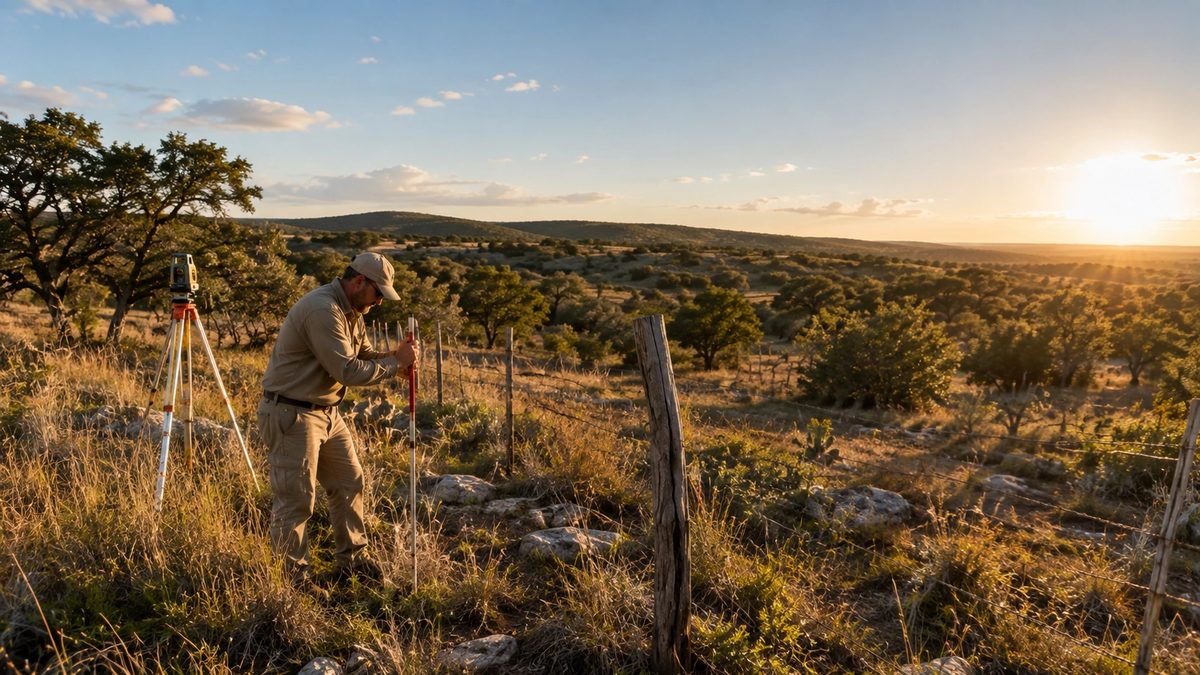
If you are buying a property with an existing structure, the septic system should be located, inspected, and confirmed to be in working order with a valid permit. If you are buying raw land, a soil percolation test during due diligence will tell you whether the site can support the type of OSSF system you need — and at what cost.
Conventional septic systems on suitable sites in Blanco County run $8,000–$18,000 installed. Properties with challenging soils or setback requirements may need an aerobic system, which costs more and requires an ongoing maintenance contract. For a complete breakdown of septic types and costs, see the article on septic systems on rural Texas land.
Internet and Cell Service in the Hill Country
Internet service is the utility buyers most consistently underestimate. The Hill Country is beautiful; it is also, in many areas, a cellular dead zone with no fixed broadband infrastructure.
Starlink
Starlink satellite internet (SpaceX) has fundamentally changed rural connectivity across the Hill Country. At most locations with an unobstructed view of the sky, Starlink delivers 50–200 Mbps download speeds — more than adequate for remote work, video streaming, and general household use. As of 2026, Starlink residential service runs approximately $120/month with a one-time equipment cost of around $500–$600 for the dish and router. This is the most reliable broadband option for remote Hill Country properties.
Fixed Wireless and Cellular
Local fixed wireless internet providers operate in parts of the region, using tower-mounted antennas to deliver 25–100 Mbps to nearby subscribers. Coverage is spotty and varies significantly by terrain — a ridge between your property and the tower eliminates service.
For cellular coverage, AT&T and Verizon have the broadest footprint in the region, though valleys and canyons create dead spots. A cellular signal at the entrance gate does not mean you will have a signal at the main house a mile in. Test coverage at the specific location on your property during due diligence — walk the building site, not just the road.
Fiber
Fiber internet has reached parts of Fredericksburg and the immediate Johnson City area, but does not extend to most rural acreage in either county. If fiber access is important to your intended use of the property, confirm specifically whether it is available at the address — not just in the general area.
Gas: Propane, Not Natural Gas
Natural gas pipelines do not serve rural properties in Blanco or Gillespie County. Properties that need gas for cooking, water heating, space heating, or a standby generator run on propane stored in above-ground or underground tanks on the property. Tank sizes range from 250 gallons (adequate for a small cabin) to 1,000+ gallons for full-time residential use, delivered by propane truck on a scheduled or on-call basis.
This is standard across the rural Hill Country — not an unusual constraint. Buyers accustomed to natural gas appliances in an urban home should factor in the cost of a propane system or appliance conversion when budgeting for development.
What to Verify Before You Close
During your due diligence period on any rural Hill Country property, confirm each of the following:
- Electric: Is PEC service active at the property, or only nearby? If not connected, get a line extension estimate from PEC before you close.
- Solar feasibility: If off-grid, assess the site's solar exposure and get a preliminary system quote.
- Water: If a well exists, review the well log and order a current water quality test. Confirm yield and static level. If no well, research costs for drilling in that area.
- Septic: Locate and inspect any existing system. On raw land, conduct a perk test to determine OSSF feasibility.
- Internet: Test Starlink availability at the address (starlink.com/map). Test cellular signal at the building site — not just at the road.
- Propane: Note whether existing infrastructure (tank, lines, appliances) is present and serviceable.