Why Cedar Comes Back
Clearing cedar once does not solve the cedar problem. Ashe juniper has two biological mechanisms that make it persistent on cleared land: aggressive resprouting and prolific reseeding. Understanding both is essential to building a realistic maintenance budget for any Hill Country property.
Resprouting from the root collar
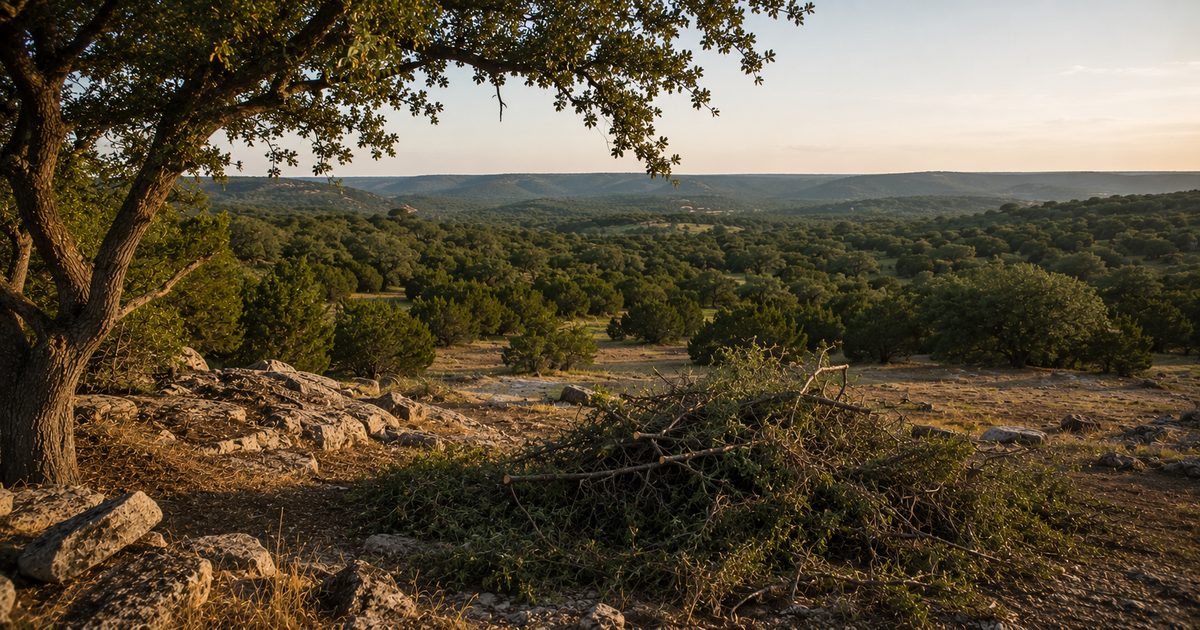
When Ashe juniper is cut — even at ground level — the root collar typically survives and sends up new growth within one to two growing seasons. A single cleared tree can produce multiple vigorous sprouts from the base, and if those sprouts are not managed within the first few years, you can have a denser stand than you started with in a decade. Mechanical clearing that mulches the above-ground growth does not address the root collar; the roots remain alive and capable of resprouting.
Root plowing — which disrupts the actual root system — reduces resprouting more effectively but is expensive and not always appropriate. Most Blanco County landowners use mechanical or hand removal of resprouts while they are small, rather than root plowing the entire property.
Continuous reseeding from neighboring properties
Cedar Waxwings, American Robins, and other birds consume Ashe juniper berries and deposit seeds across the landscape year-round. This means that even if you clear every cedar on your property, seeds from neighboring properties arrive in your soil continuously. A cleared pasture adjacent to cedared land will see new seedlings every year. Managing them before they establish — when they are small and inexpensive to remove — is far more cost-effective than waiting until they require equipment.
Long-Term Management Strategies
Prescribed burns (most cost-effective)
A well-planned prescribed burn is the single most cost-effective tool for maintaining cleared Hill Country land. Fire kills cedar seedlings and resprouts up to about knee height, promotes native grasses, and can be applied across large acreage at relatively low cost. A 3–5 year burn rotation is standard practice on properties where burning is practical. The Texas A&M Forest Service can help landowners develop burn plans and provides technical assistance.
Not every property can be burned — proximity to structures, fencing, and topography all affect feasibility. Properties with creek drainages, rock outcroppings, or irregular terrain may have limited burn windows. Consult with a certified burn manager before planning a fire management program.
Mechanical resprout removal
For areas where prescribed burning is not practical, periodic mechanical removal of resprouts — typically on a 2–3 year cycle before sprouts reach head height — is the next best option. Small skid steers with brush cutters or forestry mulching heads can work efficiently when cedar density is low. Hand removal with clearing saws or loppers is appropriate for scattered seedlings and resprouts in sensitive areas.
Herbicide spot treatment
Individual resprouts and scattered seedlings can be managed with targeted herbicide application. Triclopyr-based products applied to the cut stem or as a basal bark treatment are effective on Ashe juniper. This approach is most practical for spot management in areas where mechanical or fire treatment is impractical — around structures, on steep banks, or in areas with high wildlife habitat value.
Building Maintenance Into Your Budget
Buyers who purchase cedared properties and clear them often underestimate ongoing maintenance costs. A realistic budget includes a prescribed burn every 3–5 years ($10–$20/acre for professional assistance), mechanical resprout removal on a 2–3 year cycle for problem areas, and spot herbicide treatment annually in areas where burns are not practical. Over a 10-year period, this maintenance cost can easily total $100–$200+ per acre — a real number that should be factored into any purchase economics analysis.