Texas Is a "Fence-Out" State — With Exceptions
Texas is historically an open-range state, meaning that livestock owners are not automatically required to fence their animals in. Under the traditional common-law rule, a neighbor whose crops were damaged by roaming cattle had to build their own fence to keep animals out — not the livestock owner's responsibility to fence them in.
However, the Texas Legislature has largely reversed this through stock law elections, and most populated and agricultural counties — including Blanco County — have adopted local stock laws that require livestock owners to fence their animals in. Before assuming the open-range rule applies to your property, verify the stock law status of the specific county.
In Blanco County, livestock owners are legally required to confine their animals. An owner whose cattle or goats get onto a neighbor's land and cause damage can face liability.
Boundary Fences: Who Builds It?
The Texas Agriculture Code (Chapter 143) governs partition fences — the fences that run along the boundary line between two properties. The key principle is that when both landowners are using their land for agriculture, the cost of building and maintaining the boundary fence is shared equally.
Specifically, when a landowner wants a partition fence built and the neighbor does not voluntarily participate, the process works like this:
- The requesting landowner gives written notice to the neighbor
- County fence commissioners (appointed by the county judge) survey the line and assign each party responsibility for specific sections
- Each party is responsible for building and maintaining their assigned portion
- If a neighbor fails to maintain their section after notice, the other party may repair it and seek reimbursement
The partition fence process is rarely used in practice — most rural neighbors work out fencing informally — but it establishes the legal framework for what happens when they don't.
What Buyers Actually Encounter
In practice, the fencing situation a buyer encounters on a rural property in Blanco County usually falls into one of these categories:
- Perimeter fence in good condition. Existing fencing on all or most of the boundary lines, maintained by historical agreement or practice between adjacent landowners. The buyer inherits the existing arrangement.
- Perimeter fence in poor condition. Old fence lines that need significant repair or replacement. The cost of bringing fencing up to a standard that contains livestock can be substantial — $5,000–$20,000 or more depending on acreage and terrain. This is a known cost that should factor into offer price.
- No perimeter fence. Raw land, recently subdivided tracts, or land that was never fully fenced. Buyer is starting from scratch. Getting bids from fence contractors in Blanco County is part of due diligence.
- Disputed fence lines. Fences that were built in the wrong location relative to the legal boundary, often decades ago. Survey and title review can reveal this. Disputed fence lines require legal resolution and can be contentious.
Fence Ownership: Whose Fence Is It?
Fencing along a boundary line is complicated by the question of who owns it. Texas generally applies a "right-hand rule" as an informal custom — when you walk along your land facing your neighbor, the fence on your right is your responsibility. But this is custom, not law, and it isn't universally followed.
The only reliable answer is to look at the deed, the survey, and the historical record of who built what. In some cases, recorded easement or maintenance agreements exist. More often, the arrangement is informal and based on long-standing practice between neighbors.
From a practical standpoint: when buying a property, ask the seller which fences are theirs, who has maintained adjacent lines historically, and whether there are any fencing disputes. These conversations are standard and expected in rural real estate.
Cross-Fencing and Interior Fencing
Beyond boundary fences, many working ranches in Blanco County have interior cross-fencing that divides the property into pasture units for rotational grazing. Cross-fencing is entirely the landowner's concern — no neighbor involvement required. But it represents a significant capital investment for buyers who want to manage the land for livestock or ag exemption purposes.
Common fencing types used in Blanco County:
- Net wire (woven wire) — the standard for goat and sheep operations; keeps small animals in and predators out
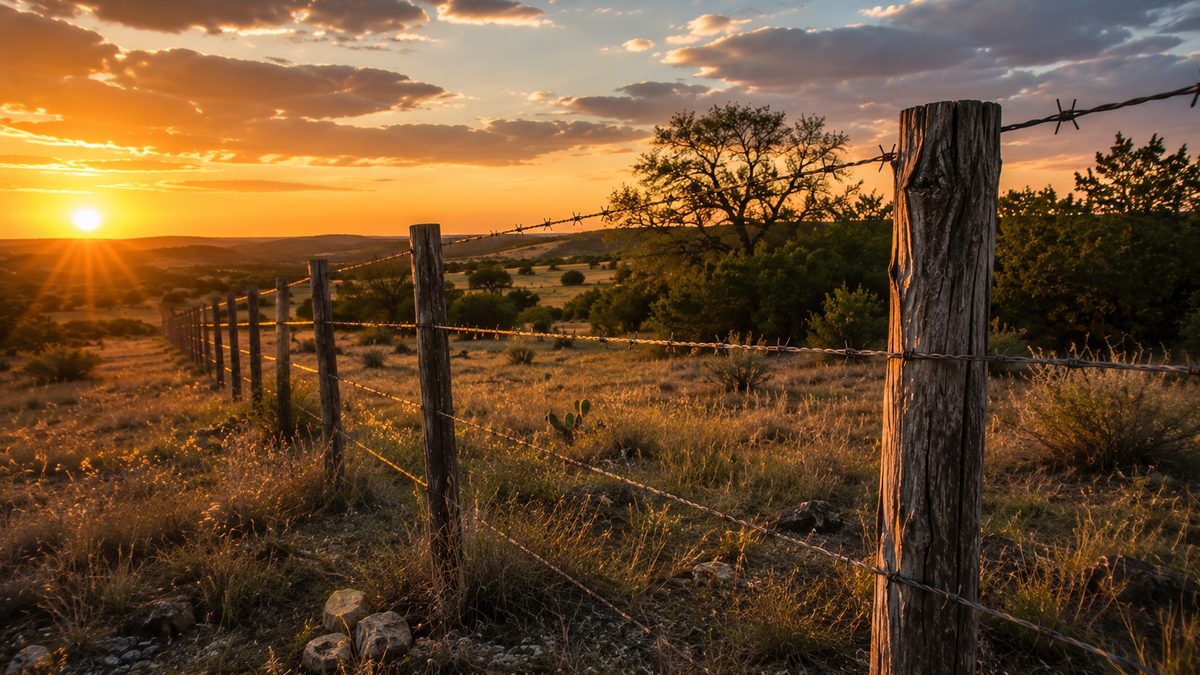
- Barbed wire — common for cattle operations; less expensive per foot than net wire, easier to maintain on rough terrain
- High-tensile wire — increasingly common for perimeter fences; longer spans between posts, lower maintenance, more expensive upfront
- Electric fence — used for interior cross-fencing in rotational grazing systems; low cost, flexible, requires power source and regular checking
Fence and Livestock Liability
In Blanco County, where the stock law requires livestock to be fenced in, an owner whose animal escapes and causes damage — including a vehicle collision on a public road — can face civil liability. The key question courts examine is whether the owner maintained their fencing in a reasonable condition. A landowner who knew a section of fence was down and failed to repair it is in a different legal position than one whose fence was in good repair and whose animal escaped through an unforeseeable break.
This is another reason fencing condition matters beyond just the practical: buyers taking on a property with deteriorated perimeter fencing are also taking on potential liability until they repair it.
What to Assess Before Closing
- Walk all accessible fence lines during due diligence — note condition, type, and any gaps
- Ask the seller about any fencing disputes or informal arrangements with adjacent landowners
- Determine whether any boundary fences are offset from the legal boundary line
- Get bids on fence repair or construction if the condition is poor
- Confirm Blanco County's stock law status and understand livestock liability
- Identify whether cross-fencing exists and whether it's adequate for your intended use